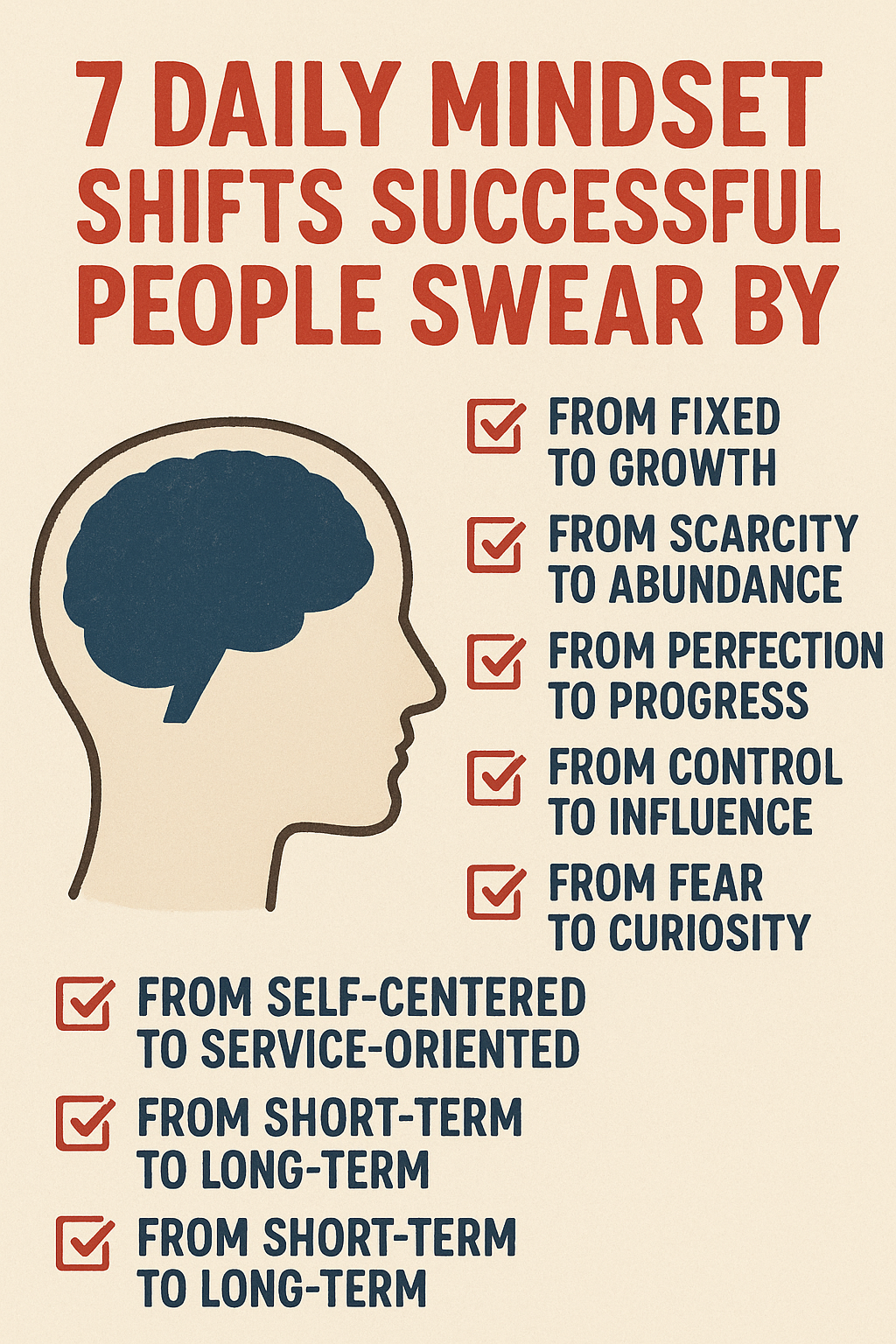
From Fixed to Growth: Seeing Challenges as Opportunities
The Shift: Instead of believing that skills and intelligence are fixed, successful people see them as expandable. They view challenges not as threats to their ability but as chances to grow.
Why It Matters: A growth mindset fuels resilience. When obstacles appear, you’re less likely to quit because you know effort leads to improvement.
Action Plan:
- Morning Practice: Write one sentence about a challenge you’re currently facing and reframe it as an opportunity (“This project isn’t proof I’m failing — it’s practice for becoming a better leader”).
- Weekly Habit: Identify one area of weakness and set a micro-goal to improve (e.g., practice public speaking for 10 minutes).
- Reframe Mistakes: At the end of each day, list one mistake and what you learned. This conditions you to see errors as stepping stones.
2. From Scarcity to Abundance: Believing There’s Enough to Go Around
The Shift: Instead of seeing the world as a zero-sum game, successful people focus on abundance. They don’t think in terms of limited opportunities, money, or success — they believe growth creates more for everyone.
Why It Matters: A scarcity mindset makes people hoard knowledge and fear competition. An abundance mindset encourages generosity, collaboration, and innovation.
Action Plan:
- Daily Gratitude: Each morning, write down three things you already have that you value (health, skills, supportive people).
- Give Before You Get: Make it a daily rule to share one resource, tip, or connection with someone — no strings attached.
- Language Shift: Replace scarcity-driven phrases like “I don’t have enough time/money” with “How can I make more time/money available?”
3. From Perfection to Progress: Prioritizing Action Over Waiting
The Shift: Successful people know perfection is an illusion. They focus on steady progress, even if imperfect, rather than waiting for the “perfect” moment.
Why It Matters: Perfectionism is paralyzing. Progress, even messy progress, compounds into mastery and results.
Action Plan:
- Daily 1% Rule: Every day, identify one thing you can improve by just 1% — send one email, tweak one line of code, do one push-up more than yesterday.
- Set 80% Standards: Before starting a task, decide on a “good enough” version (80% of perfect) and aim to finish it rather than polish endlessly.
- Track Progress, Not Perfection: Keep a visible log (journal or app) of daily steps taken toward goals. Celebrate streaks instead of flawless outcomes.
4. From Control to Influence: Focusing on What You Can Change
The Shift: Instead of wasting energy on what’s outside their control, successful people focus on what they can influence — their choices, habits, and responses.
Why It Matters: Energy spent on uncontrollable things (the economy, others’ opinions, bad weather) creates stress and helplessness. Focusing on influence builds confidence and effectiveness.
Action Plan:
- Daily Circle Exercise: Write down two lists: “Things I can’t control” and “Things I can influence today.” Put your energy into the second list.
- Practice Detachment: When frustration arises, ask, “Is this in my control?” If no, redirect energy to something actionable.
- Build Response Time: Before reacting to setbacks, pause and ask, “What’s the best response I can control here?”
5. From Fear to Curiosity: Reframing Uncertainty
The Shift: Successful people don’t let fear of the unknown paralyze them. They lean into curiosity, asking “What can I learn here?” instead of “What if I fail?”
Why It Matters: Curiosity turns obstacles into puzzles rather than threats. It keeps you experimenting, innovating, and growing.
Action Plan:
- Curiosity Journaling: End each day by writing one thing that scared you and reframing it as a question. (“What if I embarrass myself?” → “What can I learn from trying?”)
- Ask More Questions: In conversations, practice asking three open-ended questions before giving advice or offering your opinion.
- Try Micro-Experiments: Each week, deliberately try one new thing outside your comfort zone (a new class, a cold email, a new workout).
6. From Self-Centered to Service-Oriented: Creating Value for Others
The Shift: Successful people shift their focus from “What can I get?” to “What can I give?” They think in terms of contribution, not just personal gain.
Why It Matters: Service creates trust, relationships, and long-term opportunities. When you solve others’ problems, your own success follows.
Action Plan:
- Daily Service Habit: Every day, write down one way you can add value for someone (a compliment, an introduction, sharing expertise). Do it before noon.
- Shift Your Goals: When setting goals, add the question: “Who else benefits if I achieve this?”
- Build a Value Bank: Track the ways you’ve helped others — not to keep score, but to remind yourself how much impact you create.
7. From Short-Term to Long-Term: Playing the Infinite Game
The Shift: Instead of chasing quick wins, successful people think in decades, not days. They practice patience and invest in long-term growth.
Why It Matters: Short-term thinking leads to burnout, poor decisions, and shallow rewards. Long-term mindset creates sustainable success and resilience.
Action Plan:
- Daily Vision Reminder: Start each day by reviewing a vision statement or long-term goal you’ve written down.
- Invest an Hour: Dedicate one hour daily to long-term growth activities (learning, networking, building assets) instead of urgent tasks.
- Use the 5-Year Test: Before making decisions, ask, “Will this matter in five years?” If not, don’t give it too much energy.
Putting It All Together: A Daily Mindset Routine
You don’t have to master all these shifts overnight. Instead, build them into a simple daily routine:
- Morning (10 minutes):
Write down one challenge reframed as an opportunity (Growth).
Note three things you’re grateful for (Abundance).
Review your long-term vision (Infinite Game). - Midday (5 minutes):
Do one quick progress step toward a goal (Progress).
Ask yourself: “Am I focusing on what I can control right now?” (Influence). - Evening (10 minutes):
Journal one mistake and the lesson (Growth).
Write one act of service you did today (Service).
Reflect on one thing that scared you and reframe it as curiosity (Curiosity).
Over time, these small practices hardwire new thought patterns. You’ll start to see obstacles differently, engage with others more generously, and build patience for long-term success.
Conclusion
Mindset is the hidden engine behind success. Skills matter, opportunities matter, but how you think determines whether you use them effectively. The most successful people have trained their minds to move from scarcity to abundance, from fear to curiosity, from perfection to progress.
You don’t need to change everything at once. Start small. Choose one mindset shift to practice this week and follow the action plan. Next week, add another. In a year, these small shifts will add up to a new way of living.
Success doesn’t come from copying what successful people do. It comes from thinking the way successful people think — every single day.